
IS NUA REALLY WORTH IT?
When it comes to retirement planning, one strategy that often comes up for those with highly appreciated company stock in their 401(k) is Net Unrealized Appreciation (NUA). While this option may sound appealing, it’s essential to weigh its benefits against the potential drawbacks. In this blog post, we’ll explore whether NUA is truly worth it by looking at examples from Raytheon and Aetna stocks—two companies that have experienced notable stock growth over the years. By diving into what NUA is, how it works, different rules, and important considerations, and then applying it to these two companies, you can better understand if this strategy is a smart move for you.
Key Takeaways:
What is Net Unrealized Appreciation (NUA)?
How Does NUA Work?
What are the NUA rules?
Important Considerations Before using NUA
Example 1: Raytheon Stock & NUA
Example 2: Aetna Stock & NUA
Conclusion: Is NUA Really Worth It?

What is Net Unrealized Appreciation (NUA)?
Before diving into the examples, let’s first define Net Unrealized Appreciation (NUA). NUA refers to the increase in the value of company stock that you hold in your 401k. When you take a distribution of company stock from your 401k, you may be able to take advantage of favorable tax benefits on the appreciation. NUA can be a powerful strategy for tax savings, especially if you have stock in your 401k that has appreciated significantly. However, there are strict regulations and the rules surrounding NUA’s can be complex, so it is important to fully understand the regulations and/or consult a tax professional or financial advisor before applying NUA as a part of your retirement strategy.
How Does it Work?
Cost Basis: The original value of the stock when it was purchased in the 401k is considered the cost basis.
Unrealized Appreciation: The increase in value of the stock since it was purchased is the unrealized appreciation
When you withdraw company stock from your retirement account,
Cost Basis: is taxed as ordinary income when you take the distribution
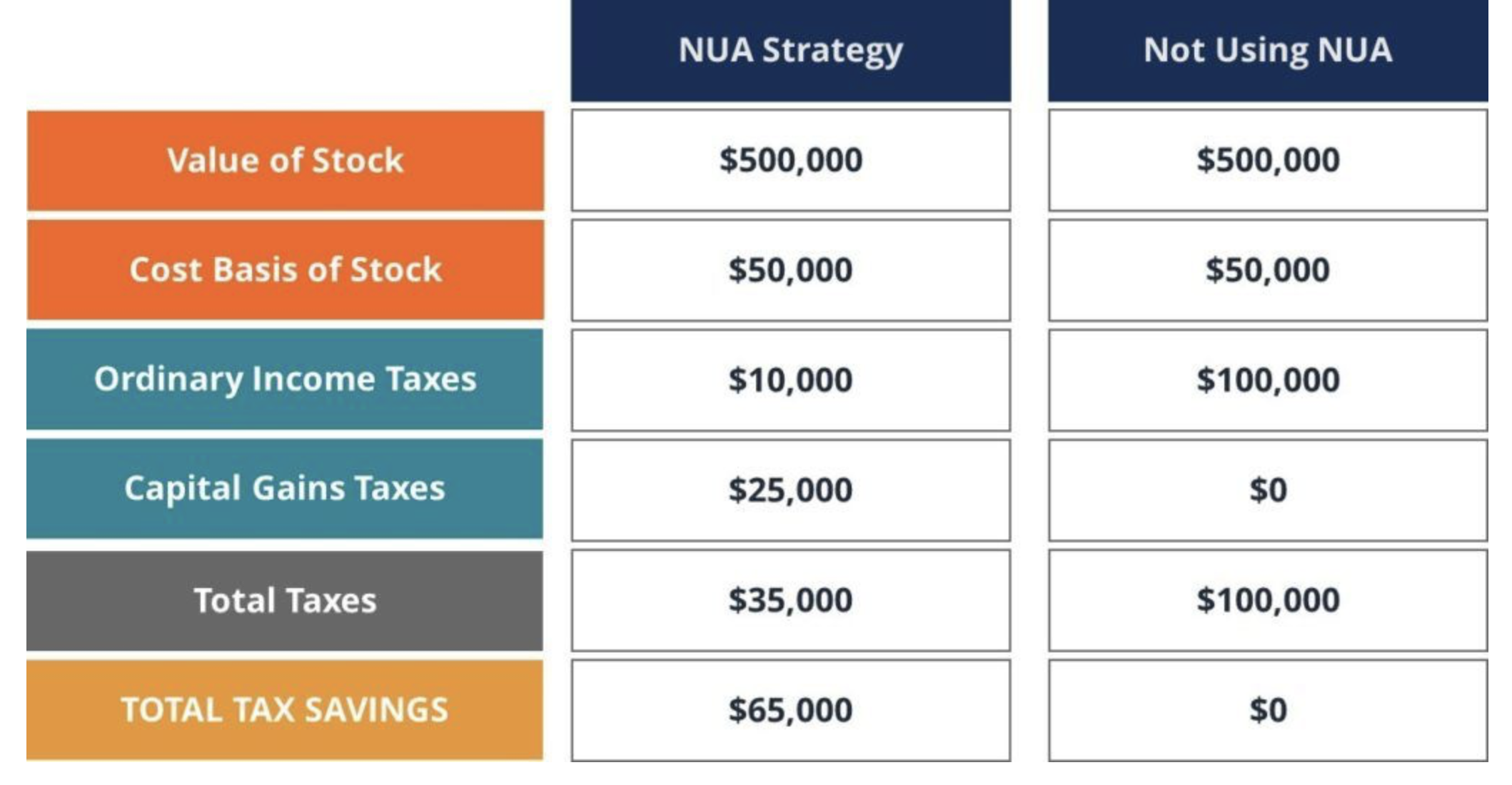
Unrealized Appreciation: is taxed at the long-term capital gains rate rather than the ordinary income tax rate, as long as you meet certain conditions, such as holding the stock outside the retirement plan for at least one year
The key benefit of the unrealized appreciation being taxed at the long-term capital gains tax rate is that it can be much lower than the ordinary income tax rate. This becomes particularly beneficial if the stock has appreciated significantly.
NUA Rules/Regulations:
1. Must Be Company Stock in the 401k
To take advantage of NUA, the distribution must include company stock (not mutual funds or other investments).
The company stock must be held in your 401k or another employer-sponsored retirement plan, such as a 403b, 457 plan, or simple IRA.
2. The Stock Must Be Distributed, Not Sold Within the Plan
For NUA to apply, you must take a lump-sum distribution of the company stock from the retirement plan and transfer it into a taxable brokerage account.
You are not allowed to sell the stock while it is still in the retirement plan, or else you’ll lose the NUA treatment.
If you decide to take the stock as a lump-sum distribution, you’ll pay ordinary income tax on the cost basis of the stock (the amount you originally paid for the stock).
The unrealized appreciation (the gain in the stock's value) is then subject to long-term capital gains tax when you sell it outside the 401k.
3. Must Be a Qualifying Distribution Event
You must experience a qualifying distribution event to take the stock out which could be:
Retirement: If you’re retiring, you can take a lump-sum distribution of the stock.
Separation from Work: If you leave your employer, you can take a distribution of the stock.
Disability or Death: In the event of a disability or death, the stock can also be distributed.
You cannot simply move the stock to a taxable account while you’re still employed unless you meet one of these criteria.
4. No Rollover to IRA
If you choose to take advantage of NUA, you cannot roll the company stock into an IRA.
To get the tax benefits of NUA, the stock must be distributed directly to a taxable account, not into another retirement account.
If you roll it into an IRA, the NUA treatment will no longer apply, and the entire amount will be taxed as ordinary income when you take distributions.
5. Holding the Stock After Distribution
After you transfer the company stock to a taxable account, you can hold onto it indefinitely. However, the timing of when you sell the stock impacts the capital gains tax rate:
If you sell the stock after holding it for more than one year, the appreciation is taxed at long-term capital gains rates.
If you sell it within a year, the appreciation will be taxed at short-term capital gains rates, which are generally the same as ordinary income tax rates.
6. It’s a One-Time Opportunity
NUA is a one-time opportunity. Once you take the stock out of your 401k and move it to a taxable account, you can no longer reallocate or transfer it to a tax-advantaged account (such as an IRA) without losing the NUA treatment.
It's essential to ensure you fully understand how NUA works before initiating a distribution.
Important Considerations Before Using NUA:
Tax Bracket Impact: NUA is especially beneficial for individuals who are in a high tax bracket during their working years and expect to be in a lower tax bracket in retirement. This is because the appreciation (NUA) will be taxed at the lower long-term capital gains rate, which can offer substantial tax savings.
Large Stock Appreciation: NUA is most beneficial when the company stock has appreciated significantly. If the stock hasn't increased much in value since you purchased it, the tax savings may not be as substantial.
Retirement Timing: If you plan to retire soon, NUA may be an appealing option, as it allows you to potentially save on taxes when withdrawing funds. However, if you don’t plan on retiring soon, you might want to delay this strategy.

Example 1: Raytheon Stock and NUA
Raytheon Technologies is a well-known defense contractor with a long history of growth. Let’s assume that you have Raytheon stock in your 401k and are considering whether NUA is the right strategy for you.
Scenario:
Cost Basis: $50,000 (the amount you initially invested in Raytheon stock in your 401k).
Current Market Value: $250,000 (the current value of your Raytheon stock in your 401k).
Unrealized Appreciation (NUA): $200,000 (the difference between your cost basis and the current value, $250,000-$50,000).
If you decide to take advantage of NUA, you could transfer the Raytheon stock from your 401k to a taxable brokerage account. Here's how the taxation would break down if you are in the 24% tax bracket:
Ordinary Income Tax: You would pay ordinary income tax on the $50,000 cost basis. For example, you’d owe:
$50,000 * 24% = $12,000 in taxes.
Long-Term Capital Gains Tax: The $200,000 appreciation would be taxed at the long-term capital gains rate, which is typically 15% or 20%, depending on your income level. Say you’re in the 15% capital gains bracket, you’d owe:
$200,000 * 15% =$30,000 in taxes on the appreciation.
Tax Breakdown:
Ordinary Income Tax on $50,000: $12,000 (24% of $50,000).
Capital Gains Tax on $200,000: $30,000 (15% of $200,000).
Total Tax: $42,000.
If you had sold the stock directly from your 401k (without NUA), you would have paid ordinary income tax on the entire $250,000, which could result in a much higher tax… assuming 24% tax bracket from above: $250,000 * 24% = $60,000.00
In this scenario, utilizing NUA would be worth it as it could save you a significant amount in taxes. You’re paying ordinary income tax only on your initial investment, while the bulk of the gain is taxed at the lower capital gains rate.

Example 2: Aetna Stock and NUA
Aetna, the health insurance giant, is another company whose stock could be found in 401k plans. With this example, we are assuming you hold Aetna stock and are contemplating whether to use NUA when you retire.
Scenario:
Cost Basis: $30,000 (the amount you invested in Aetna stock).
Current Market Value: $120,000 (the current value of your Aetna stock in your 401(k)).
Unrealized Appreciation (NUA): $90,000 (the increase in value).
If you decide to take advantage of NUA, you could transfer the Aetna stock from your 401k to a taxable brokerage account. Here's how the taxation would break down if you are in the 24% tax bracket:
Ordinary Income Tax: pay ordinary income tax on the $30,000 cost basis.
$30,000 * 24% = $7,200 in taxes.
Long-Term Capital Gains Tax: The $90,000 appreciation would be taxed at the capital gains rate of 15%,
$90,000 * 15% =$13,500 in taxes on the gain.
Tax Breakdown:
Ordinary Income Tax on $30,000: $7,200 (24% of $30,000).
Capital Gains Tax on $90,000: $13,500 (15% of $90,000).
Total Tax: $20,700.
Had you sold the stock directly from your 401k and paid ordinary income tax on the full $120,000, your tax bill could have been around $28,800 (24% of $120,000), making NUA a beneficial strategy in this case as well.
Even though the tax savings here are not as significant as with Raytheon stock (due to the smaller appreciation), NUA still offers a valuable opportunity to pay taxes at the lower long-term capital gains rate on the appreciation rather than the higher ordinary income tax rate on the full amount.
Is NUA Really Worth It?
So, is NUA really worth it? The answer depends on all factors discussed above, including:
The Amount of Appreciation: The more your stock has appreciated, the more beneficial NUA becomes. Large gains, like those seen in Raytheon stock, can result in significant tax savings.
Your Current Tax Bracket: If you are in a high tax bracket during your working years, NUA offers the opportunity to reduce your tax liability on gains by paying long-term capital gains rates instead of ordinary income tax rates.
The Holding Period: The stock must be held in the 401(k) until the time of distribution to qualify for NUA treatment, which could be an issue if you’re looking to sell soon or if your retirement timeline doesn’t align with the strategy.
NUA can be a very effective strategy for retirees with significant stock appreciation in their 401k. However, it's not always the best choice for everyone. The benefits of NUA should be weighed against other retirement and tax strategies.
In the case of both Raytheon and Aetna stocks, NUA has proven to be a worthwhile tax strategy for those who hold significant appreciation in company stock within their retirement accounts. By transferring these stocks to a taxable account, you can take advantage of lower long-term capital gains tax rates and reduce your overall tax burden in retirement.
Thanks for reading!
