
7 Year-End Tax Moves Pre-Retirees in 2026
Are you still working, approaching retirement, and looking for ways to reduce your 2026 tax bill? The final months of the year can be an excellent opportunity to review your finances and make strategic decisions that could help you save more for retirement while potentially reducing your taxes.
The challenge is that many valuable tax-planning opportunities have year-end deadlines. Once December 31 passes, you may lose the opportunity to take advantage of certain strategies for the 2026 tax year.
In this article, I'll discuss seven year-end tax moves for 2026 that pre-retirees should consider, including maximizing retirement contributions, using after-tax contributions and Roth conversions, charitable giving, and taking advantage of tax-advantaged education and healthcare accounts.
1. Maximize Your Pre-Tax Retirement Contributions
One of the simplest ways to potentially reduce your taxable income before the end of 2026 is to increase contributions to your employer-sponsored retirement plan.
Depending on your employer, you may have access to a:
Traditional 401(k)
403(b)
Governmental 457(b)
SIMPLE IRA
When you contribute to an eligible pre-tax retirement plan, those contributions generally reduce your current federal taxable income, allowing you to defer income taxes until the money is withdrawn.
2026 401(k), 403(b), and 457(b) Contribution Limits
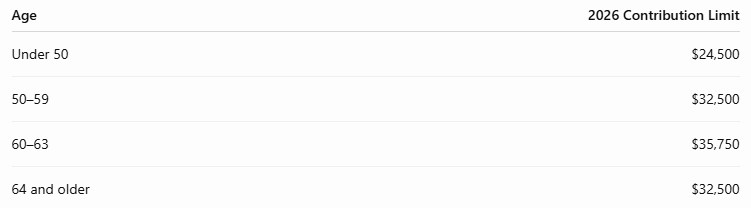
These amounts assume the participant is eligible to make the applicable catch-up contributions.
Important Change to Catch-Up Contributions in 2026
Beginning in 2026, certain higher-income employees must make their catch-up contributions on a Roth basis rather than a pre-tax basis.
This means those catch-up contributions won't provide the same immediate income-tax deduction.
However, Roth contributions can still offer valuable long-term tax advantages, including potentially tax-free qualified withdrawals in retirement.

What Should You Do Before December 31?
Review your most recent paycheck and determine how much you've contributed to your retirement plan so far in 2026.
If you're on track to contribute less than the annual maximum and have sufficient cash flow, consider increasing your contribution percentage for your remaining pay periods.
For higher-income pre-retirees who anticipate being in a lower tax bracket after retiring, maximizing pre-tax contributions may be particularly attractive.
However, the decision between pre-tax and Roth contributions should always consider your current and expected future tax situation.
2. Consider After-Tax 401(k) Contributions
What if you're already maximizing your regular 401(k) contributions but want to save even more for retirement?
Depending on your employer's retirement plan, you may be able to make additional after-tax 401(k) contributions.
These contributions differ from both traditional pre-tax contributions and designated Roth 401(k) contributions.
After-tax contributions don't reduce your current taxable income.
However, they may provide an opportunity to move additional retirement savings into a Roth account through a strategy commonly called the mega backdoor Roth.
How After-Tax 401(k) Contributions Work
Certain employer retirement plans permit contributions beyond the regular employee elective-deferral limit.
The amount you can contribute depends on several factors, including:
The overall annual plan contribution limit
Your regular employee contributions
Employer matching contributions
Employer profit-sharing contributions
Your plan's specific rules
For 2026, the general defined-contribution annual additions limit is $72,000, excluding qualifying catch-up contributions.
This can potentially create additional savings opportunities for employees who have already maximized their regular 401(k) contributions.
Why Would You Make After-Tax Contributions?
The primary benefit is the potential to move additional money into a Roth account.
Unlike ordinary pre-tax retirement distributions, qualified Roth distributions can generally be withdrawn tax-free.
However, your employer's plan must permit the necessary after-tax contributions and applicable Roth conversion or rollover options.
Not every retirement plan offers these features.
Before making additional contributions, contact your plan administrator to determine what options are available.
Click here to get your FREE electronic copy of:
Fiduciary - How to Find, Hire, and Establish an Aligned Trusted Partnership with a Fee-Only Financial Advisor
3. Evaluate In-Plan Roth Conversions
If your employer allows after-tax 401(k) contributions, the next strategy worth investigating is an in-plan Roth conversion.
This involves moving eligible amounts from an after-tax account within your employer-sponsored retirement plan into the designated Roth portion of that plan.
Why Convert After-Tax Contributions to Roth?
Let's assume you contribute $20,000 in after-tax money to your employer's 401(k).
The $20,000 contribution itself has already been taxed.
However, if you leave those contributions in the non-Roth after-tax portion of your retirement plan, future investment earnings are generally treated as pre-tax earnings.
By converting eligible after-tax contributions into the Roth portion of your plan, you may be able to position future investment growth for tax-free treatment, assuming the applicable Roth distribution requirements are satisfied.
Be Careful About Existing Investment Gains
Suppose you previously contributed $40,000 in after-tax money to your retirement plan.
Over time, that account grows to $80,000.
You now have:
$40,000 in after-tax contributions
$40,000 in investment earnings
If you convert the entire $80,000 to Roth, the $40,000 of previously untaxed earnings would generally be taxable as ordinary income.
That's why the timing of an in-plan Roth conversion matters.
Some retirement plans offer automatic conversions of eligible after-tax contributions, which can help limit the amount of investment earnings accumulated before conversion.
What About an In-Service Rollover?
Another possibility is an in-service distribution, if permitted by your employer's plan.
Under applicable rollover rules, it may be possible to direct the after-tax portion of an eligible distribution into a Roth IRA while directing the pre-tax portion into a traditional IRA.
This can potentially allow the after-tax contributions to move into a Roth IRA without converting the associated pre-tax earnings into taxable Roth income.
However, the transaction must be properly structured and permitted under the plan.
Traditional Roth Conversions Are Another Option
You don't need after-tax 401(k) contributions to consider a Roth conversion.
If you have money in a traditional IRA or eligible employer retirement account, you may be able to convert pre-tax funds into a Roth IRA.
The conversion generally creates taxable income in the year it occurs.
But if you're experiencing an unusually low-income year, or expect to be in a higher tax bracket in the future, a Roth conversion could potentially make sense.
The key is evaluating whether paying taxes now could reduce your lifetime tax burden.
4. Consider a Donor-Advised Fund for Charitable Giving
If you're charitably inclined but rarely itemize deductions, a donor-advised fund (DAF) may be worth considering.
A donor-advised fund is a charitable giving account that allows you to contribute assets, potentially receive an income-tax deduction, and recommend grants to eligible charities over time.
How a Donor-Advised Fund Works
Suppose you typically donate $5,000 annually to charities.
Depending on your other itemized deductions, that amount may not be enough to make itemizing more beneficial than claiming the standard deduction.
Instead, you might consider contributing several years' worth of charitable donations into a donor-advised fund in one tax year.
For example, you could contribute $25,000 to a DAF in 2026 and then recommend grants to your preferred charities over the following several years.
This strategy is sometimes called charitable contribution bunching.
The larger contribution could potentially make itemizing deductions more beneficial in the year you fund the DAF.
Benefits of a Donor-Advised Fund
A donor-advised fund can provide several potential advantages:
Consolidating charitable contributions
Potentially increasing itemized deductions in a particular year
Allowing assets to be invested within the fund
Recommending charitable grants over time
Simplifying charitable giving
However, contributions to a donor-advised fund are generally irrevocable, and the sponsoring organization retains legal control of the contributed assets.
Your deduction also depends on applicable IRS limits and your overall tax situation.
A donor-advised fund is most appropriate when charitable giving is already part of your financial plan.

5. Contribute to a 529 College Savings Plan
If you have children or grandchildren who may attend college, contributing to a 529 college savings plan could provide another tax-planning opportunity.
A 529 plan is a tax-advantaged account designed to help families save for eligible education expenses.
Contributions aren't deductible on your federal income-tax return.
However, many states provide state income-tax deductions or credits for qualifying contributions.
Connecticut 529 Tax Deduction
For Connecticut residents, contributions to an eligible Connecticut 529 plan may qualify for a state income-tax deduction.
The annual deduction can be up to:
$5,000 for an individual filer
$10,000 for married taxpayers filing jointly
Connecticut's CHET program is one option to investigate when considering these benefits.
Why Make a 529 Contribution Before Year-End?
If you're planning to contribute to a 529 plan anyway, making an eligible contribution before the applicable year-end deadline may allow you to claim the state tax benefit for 2026.
The potential benefits extend beyond the immediate deduction.
Investment earnings within a 529 plan can generally grow tax-free, and qualified withdrawals can also be tax-free when used for eligible education expenses.
Before contributing, review your state's specific requirements, contribution limits, and eligible plans.
6. Use a Flexible Spending Account (FSA)
Another tax-saving strategy involves a healthcare Flexible Spending Account, commonly called an FSA.
An FSA allows eligible employees to set aside money through their employer for qualifying healthcare expenses.
Contributions are generally made on a pre-tax basis, potentially reducing federal income taxes and certain payroll taxes.
What Expenses Can an FSA Cover?
Depending on the plan and applicable rules, eligible expenses may include:
Medical copayments
Prescription medications
Dental expenses
Vision expenses
Certain medical supplies
Other qualifying healthcare costs
If you know you're going to incur substantial out-of-pocket medical expenses, contributing to an FSA may help you pay those costs with tax-advantaged dollars.
Understand the FSA Use-It-or-Lose-It Rule
One of the biggest drawbacks of an FSA is that unused money may be forfeited.
Some employers offer a limited carryover provision or a grace period, but these options depend on the plan.
That's why it's important to estimate your eligible healthcare expenses carefully.
Unlike an HSA, a typical healthcare FSA generally isn't designed to accumulate investments for long-term retirement expenses.
What Should You Do Before Year-End?
Review your employer's benefits and open-enrollment deadlines.
If you already have an FSA, check your remaining balance and your plan's deadlines for incurring expenses and submitting reimbursement claims.
If you're enrolling for the upcoming plan year, consider how much you're realistically likely to spend on qualifying healthcare expenses.
7. Maximize Your Health Savings Account (HSA)
If you're enrolled in an eligible high-deductible health plan, one of the most valuable tax-advantaged accounts available may be a Health Savings Account, or HSA.
HSAs offer a unique combination of tax advantages.
Eligible contributions can reduce taxable income.
Investment growth is generally tax-free for federal income-tax purposes.
And withdrawals used for qualified medical expenses are generally tax-free.
This combination makes an HSA particularly attractive for people who are preparing for retirement.
Why an HSA Can Be So Valuable
Unlike an FSA, unused HSA funds generally remain in your account from year to year.
You don't have to spend the money before December 31 simply because the calendar year is ending.
You may also be able to invest the money in stocks, mutual funds, or other available investment options, depending on your HSA provider.
That means an HSA can potentially become a long-term healthcare savings account.
Consider Paying Current Medical Expenses Out of Pocket
One strategy I often discuss is paying eligible medical expenses out of pocket while allowing HSA funds to remain invested.
If you keep appropriate documentation, you may be able to reimburse yourself from your HSA years later for qualified medical expenses incurred after the HSA was established.
This allows you to preserve money inside the HSA for potentially longer periods of tax-advantaged growth.
Of course, this strategy is most appropriate when you have sufficient cash flow and emergency savings to cover current healthcare costs without using the HSA.
What Happens to Your HSA After Age 65?
Once you reach age 65, you can generally take nonqualified withdrawals from your HSA without the additional 20% tax that would ordinarily apply to nonqualified distributions at younger ages.
However, those nonqualified withdrawals are still generally subject to ordinary income tax.
Qualified medical withdrawals can remain tax-free.
One important distinction: enrolling in Medicare generally ends your eligibility to make new HSA contributions, even though you can continue using the money already in your account.
This is especially important for pre-retirees approaching Medicare eligibility.
Which Year-End Tax Moves Have a December 31 Deadline?
Not every strategy discussed above has exactly the same deadline.
Tax StrategyImportant Timing ConsiderationPre-tax 401(k), 403(b), or 457(b) contributionsGenerally must be made through eligible payroll for the applicable calendar yearAfter-tax 401(k) contributionsSubject to employer plan rules and payroll deadlinesIn-plan Roth conversionsGenerally must be completed in 2026 to be treated as a 2026 conversionDonor-advised fund contributionsGenerally must be completed by the applicable charitable contribution deadline for 2026529 contributionsState-specific deadlines apply to claiming a 2026 state tax benefitHealthcare FSAEmployer election, expense, and reimbursement deadlines varyHSA contributionsEligible 2026 contributions can generally be made until the 2027 federal tax-filing deadline, excluding extensions
The important takeaway is that not every tax-saving opportunity disappears on December 31, but many payroll-related and charitable strategies require action before the calendar year ends.
How Should Pre-Retirees Prioritize These Tax Strategies?
Not every strategy will make sense for every individual.
For example, someone approaching retirement in a high tax bracket may benefit from maximizing pre-tax retirement contributions.
Another person who expects significantly higher taxes later may benefit more from Roth contributions or conversions.
A family paying for college may want to prioritize a 529 contribution.
And someone enrolled in an HSA-eligible health plan may want to maximize that account before considering additional taxable investment contributions.
The best strategy depends on your individual circumstances.
I would encourage you to evaluate:
Your current marginal income-tax bracket
Your expected retirement tax bracket
How much you've already contributed to retirement accounts
Your employer's available plan features
Your expected healthcare expenses
Your charitable giving goals
Your education savings goals
Your available cash flow
The goal shouldn't simply be to reduce this year's tax bill at any cost.
It should be to make decisions that improve your overall financial position and potentially reduce taxes over your lifetime.
Final Thoughts: Don't Miss These 2026 Tax-Saving Opportunities
As we approach the end of 2026, now is an excellent time to review your retirement savings and tax strategy.
Whether you're maximizing pre-tax retirement contributions, evaluating Roth conversions, contributing to a 529 plan, or taking advantage of an HSA, there may still be opportunities to improve your financial situation before the year ends.
But remember that tax strategies work best when they're coordinated.
A decision that reduces your taxes today isn't automatically the best decision for your retirement.
The most effective retirement tax planning considers both your current tax bill and the taxes you may pay throughout retirement.
Have a great week—and I’ll talk to you next Tuesday.
Written by Ryan Morrissey CFP®, CLU®, CHFC®, CMFC
Founder & Principal Advisor of Morrissey Wealth Management
Host of the Retire with Ryan Podcast
___________________________________________________________________________________________________________________________
Frequently Asked Questions
What are the best year-end tax moves for 2026?
Potential strategies include maximizing pre-tax retirement contributions, evaluating after-tax 401(k) contributions, considering Roth conversions, funding a donor-advised fund, contributing to a 529 plan, using an FSA, and maximizing an HSA.
How can I reduce my taxable income before December 31, 2026?
Depending on your eligibility, increasing pre-tax retirement contributions and making deductible charitable contributions may reduce your 2026 taxable income. Other strategies, such as 529 contributions, may offer state-level tax benefits.
What is the 401(k) contribution limit for 2026?
The regular employee elective-deferral limit is $24,500 for 2026. Eligible employees age 50 and older may make additional catch-up contributions.
Can I make after-tax 401(k) contributions after maxing out my regular contributions?
Potentially. Some employer-sponsored retirement plans allow additional after-tax contributions, subject to annual limits and plan rules. These contributions may support a mega backdoor Roth strategy.
Can I do a Roth conversion before the end of 2026?
Yes, if you have eligible retirement assets and complete the conversion by the applicable deadline. The taxable portion of the conversion generally increases your 2026 taxable income.
Are 529 contributions deductible on federal income taxes?
No. However, certain states offer state income-tax deductions or credits for eligible 529 contributions.
Is an FSA or HSA better for retirement savings?
An HSA is generally better suited for long-term healthcare savings because unused funds can remain in the account and may be invested. An FSA is generally intended to help pay eligible healthcare expenses within the applicable plan period.
Can I contribute to my HSA after December 31, 2026?
Generally, yes. Eligible contributions for the 2026 tax year can typically be made until the federal income-tax filing deadline in 2027, excluding extensions.
Should I choose pre-tax or Roth retirement contributions before retirement?
The decision depends on your current and expected future tax rates, income, retirement plans, and other factors. Pre-tax contributions may be attractive when your current marginal tax rate is higher than your expected future rate, while Roth contributions may be more attractive in the opposite situation.